Commercial Roofing in Thompson Lane, Murfreesboro, TN
Commercial roofing on Thompson Lane starts with roof access, drainage, and the work zone. We inspect the assembly and set a repair scope around operations.
Thompson Lane
Commercial roofing along Thompson Lane begins with the building's use and roof access. In Murfreesboro, TN, the corridor connects to medical and office development near Medical Center Parkway, while planned road widening reaches from Broad Street to Memorial Boulevard. That context makes delivery timing and site circulation worth confirming before the crew arrives. It does not identify a property's roof type or hours. We inspect the assembly, mark the active section, and build the work window around the building's actual operation.
The first walk records seams, drains, curbs, edges, roof penetrations, and prior repairs. We compare the visible roof with drawings and service records, then separate confirmed findings from areas that need a test. A commercial roof should have a clear repair boundary and a daily tie-in that can be closed before the weather changes. For nearby work tied to the same developing corridor, review Medical Center Parkway and Broad Street.
Confirm access and staging
We begin at the roof access point and walk the route a crew and materials will use. The inspection records hatch or ladder location, lift placement, restricted drives, loading windows, and equipment that cannot be interrupted. If a property shares a driveway or receiving area, we coordinate the time and clear area with the site contact. A staging plan should keep drains open and give the crew a protected route to the work zone.
Thompson Lane is a corridor with planned transportation improvements between Broad Street and Memorial Boulevard. That road context can affect how a delivery is scheduled, but the property's own entrance and operating rules are what control the plan. We confirm those conditions directly rather than assume traffic or parking from a corridor map. Our roof condition report can show the access route and each section checked, which helps the next visit start from the same location.
When a leak crosses a tenant boundary or reaches an active space, we agree on temporary protection and the interior contact before starting a test. The access route, ceiling condition, and any equipment below the work area become part of the field record. That information helps the owner decide whether to schedule a limited repair now or coordinate a broader opening during a planned shutdown.
Trace the drainage path
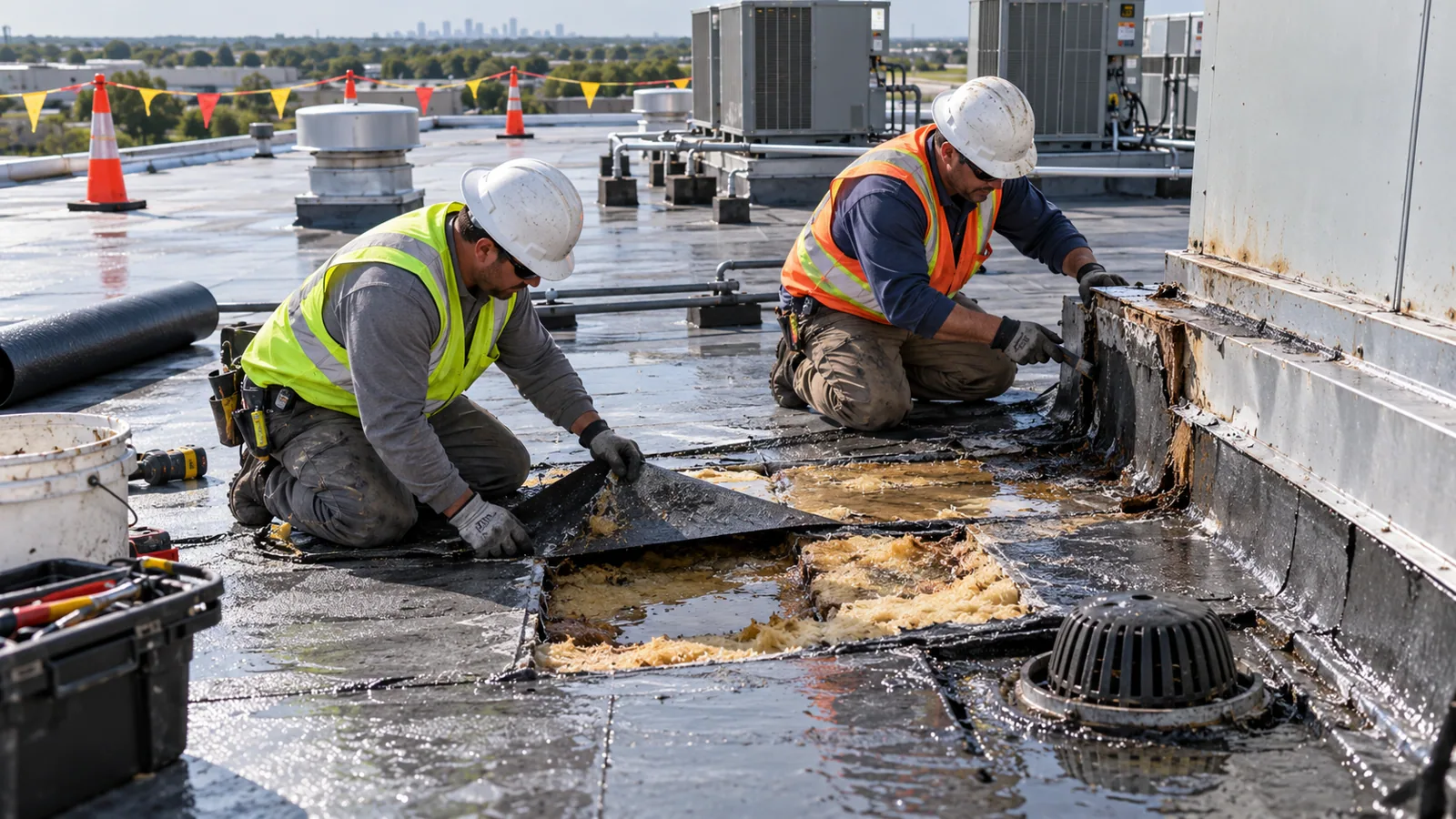
At each low point, we check the strainer, drain bowl, overflow, scupper, and membrane tie-in. A blocked outlet calls for cleaning; a low area that remains after the bowl is clear can point to a slope or insulation issue. We photograph standing water and debris before making any change, then record what the approved work corrected. If water comes in at a curb or parapet, we map the path from that detail to the interior report instead of treating the nearest drain as the cause.
For the Murfreesboro 5 N station, the 1991 to 2020 record gives a 55.92-inch annual precipitation normal; the average number of days reaching 0.01 inch is 134.5. That city-level context supports regular drainage checks on roofs along Thompson Lane. It does not prove ponding or leakage at any property. We inspect the actual roof slope and outlets, then separate maintenance from membrane repair or deck correction. A drain and scupper repair may address a failed outlet connection, while any tapered insulation or structural scope remains a separate choice.
Inspect seams and penetrations
We look for open laps, loose flashing, punctures, cracked sealant, and prior patches that no longer bond. At a pipe boot or equipment curb, the membrane turn-up and the object it meets need to be checked as one detail. A repair should extend to material that can be cleaned and prepared, not end at the visible edge of the stain. When the assembly has multiple layers, we may recommend a test cut to learn whether moisture or deck condition changes the scope.
Thompson Lane's connection to the highly developed Medical Center Parkway area means some properties may have tenant or equipment constraints; we verify each site instead of making that assumption from the corridor. A work phase can keep an adjacent roof area operating if the daily tie-in and access route are defined. Our commercial leak repair follows the water path through seams and penetrations, and TPO system work is selected only when the installed assembly supports it.
Choose a repair boundary
A localized repair is a practical option when the surrounding roof and substrate remain sound. If leaks recur across several sections, moisture extends under the membrane, or the deck is deteriorated, a broader scope may be justified. We compare repair, recover, and tear-off with the condition evidence, access limits, and work needed to keep the building dry. The estimate lists the tie-ins, materials, and unknowns rather than treating a roof-wide replacement as the default.
Inside Murfreesboro, applicable existing commercial, industrial, and multifamily projects follow the locally amended 2024 Existing Building Code. Some roof-covering replacements are excepted from permitting when defined conditions about the deck, framing, or replacement assembly are met. Confirm the current rule against the project's full scope with the City. A recover evaluation can identify existing layers and attachment before an overlay becomes an option. If condition data is incomplete, a commercial roof inspection can establish the field baseline first.
Keep the property in service
Before mobilization, we agree on the loading window, where materials can be set, and how the crew will protect rooftop units or active intake paths. Each phase identifies the roof section being opened, the tie-in to close, and the person who can approve access. If the work touches a curb serving a critical room, we coordinate with the facility contact before moving or covering anything. A weather hold leaves a defined protection check, not an open question for the next shift.
At closeout, dated photos show the seam, drain, curb, or edge that was repaired. We mark the work boundary and record anything that needs a later test or repair. That record belongs with the roof plan and maintenance file, so a new leak report can be compared against the last inspection. If a roof in the corridor is due for a longer-term review, our capital planning service can organize repair and replacement decisions, while Sika Sarnafil service applies when that system is present. Set access with the person who controls the roof.
Commercial Roofing Questions
Does the Thompson Lane widening affect roof work?
It may affect deliveries or the route to a site, but the property entrance and operating schedule control our plan. We confirm the available staging area and loading window with the facility contact before mobilization.
How do you determine whether a roof leak is from a drain?
We inspect the bowl, strainer, overflow, slope, membrane connection, and nearby details, then compare them with the interior report. The closest drain is not treated as the cause unless the roof findings support it.
Can a repair be limited to one roof section?
Yes, when the defect is localized and the adjacent assembly can accept a sound tie-in. We mark the repair boundary and list any moisture, deck, or seam condition that could require a wider scope.
What information is useful before a roof inspection?
A roof plan, earlier repair records, leak locations, and access rules help us start efficiently. We verify those records in the field and record any drawing that no longer matches the roof.
How do you handle a weather delay?
We close the planned tie-in, protect any open area, and record what needs a condition check before restarting. The site contact gets the next access and loading window confirmed before the crew returns.
Related Roofing Work
More commercial roofing work connected to Thompson Lane in Murfreesboro.

Schedule a Thompson Lane roof walk
Share the reported issue, roof plan, and site access limits. We will inspect the assembly, mark the drainage and repair findings, and return a written scope with practical phasing.